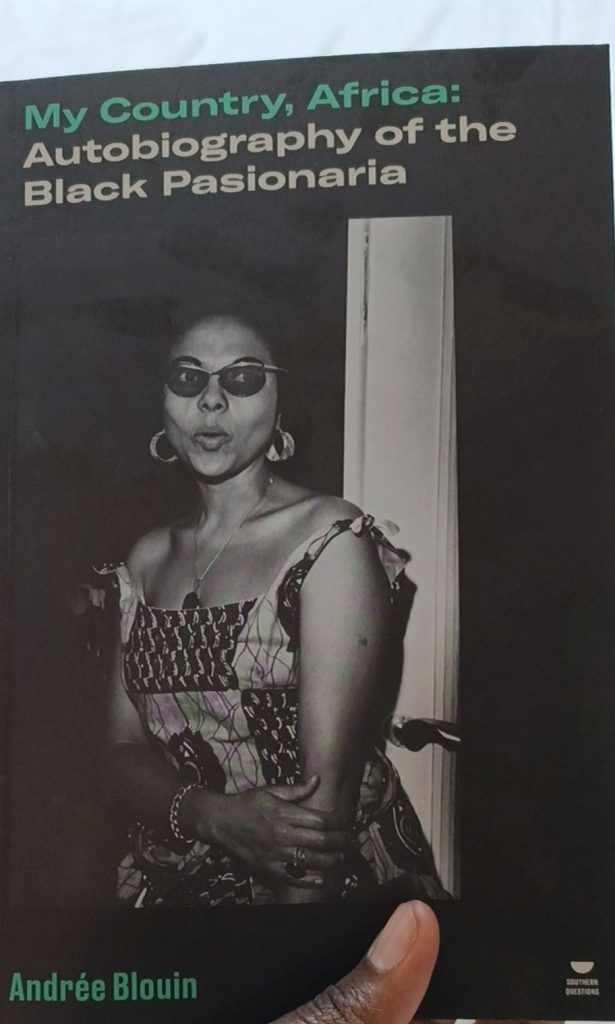
My Country, Africa is a powerful autobiography that recounts Andrée Blouin’s personal life, family and political work. Born to a white French father and a black mother at a time when colonialism dominated Congo, Andrée experienced deep-rooted racism and injustice, which eventually led her to become one of the most outspoken political figures in Africa at that time.
Although I have read stories about colonialism before, I found this book particularly sad and heartbreaking. It took me a while to decide whether I could write a review at all.
At the beginning of the book, Andrée recounts how she was sent to an orphanage (which she refers to as a ‘prison’), specifically for girls of mixed race. There, the nuns physically and mentally tortured the girls and used religion to instil fear in them. It is at the orphanage that she first learns about the struggle for freedom in her country.
Throughout her life, Andrée continues to experience incomprehensible discrimination, both as a black person and as a woman. However, it is not until her own son dies after being denied quinine because he was not white enough that she begins to make radical political moves.
´...he replied, ´You know very well that we can’t make exceptions to the rule. Quinine is for whites only. You are black. That makes your son black.’ (pg. 151)
Emerging themes:
Religion
Religion was one of the biggest drivers of colonialism, and this is no different in the memoir. Its impact on most colonised countries, for example in Africa, remains significant to this day. Having attended a school run by nuns myself, I found Andre’s experiences at the orphanage somewhat familiar. I’m not implying that all religious institutions are the same, but a large proportion (at least during my time at school) were run with extreme strictness and rules that made students scared of the nun´s wrath and authority.
In Blouin’s memoir, the nuns go to great lengths to instil a deep fear of sin in the girls.
‘We became so terrified of our sins that our bodies actually shook at the nuns’ warnings and predictions. At night, we suffered dreadful nightmares and sometimes screamed with fear.’ (pg. 22)
Given that religion emphasises love, among other things, it is ironic that the nuns promoted racism, deprived the children of food and treated them horribly.
Outside the orphanage, the missionaries encouraged the Congolese not to fight for their rights in their own country.
´´…The missions collaborated constantly with the colonialists in their policies of subverting and repressing the blacks. From the pulpit on Sundays the African people were rugularly tongue-lashed for their whim of desiring emancipation´´ pg.211
Fight for Freedom
In the fight for a free Africa, Madame Blouin worked with key political figures such as Patrice Lumumba and Sekou Touré. It was a difficult role in which she had to struggle not only for her position as a woman in male-dominated initiatives, but also risk her life and that of her family.
Blouin’s courage and determination are admirable, and it is through her political encounters that the reason for the book’s title, My Country, Africa, becomes evident. Her ambition is not limited to a free and united Congo; it extends to all other African countries. She ends up visiting and working side by side with other African leaader from countries such as Algiers, Guines, and Mali among others.
Despite her significant contributions, it was surprising to me that there is little known or mentioned about her in the historical records.
This also made me wonder how many other women’s contributions were sidelined and barely recognised in the pre- and post-colonial eras.
Political Betrayal
As in many countries, the fight for independence came with its own set of challenges. But perhaps one of the biggest obstacles was the betrayal of African leaders who collaborated with white colonialists for their own selfish reasons. This betrayal and selfishness led to the cruel assassination of Patrice Lumumba. Blouin recounts the painful events that led to Lumumba’s capture and execution.
“As I look back, I think the hardest thing for us to bear during the long struggle for viable statehood has been the knowledge that it is not outsiders who have damaged Africa most, but the mutilated will of the people and the selfishness of some of our own leaders. There are politicians among us who serve neocolonialism for their own interests and sell out their black brothers and sisters to do so. They are our worst enemies.” (pg. 269)
Racism and white dominance
As mentioned earlier, racism was one of the key themes of Blouin’s memoir. Although she tries to combat this vice, her actions are questionable too. For instance, she married Charles, a Frenchman whom she admitted was racist, yet she stayed married to him. Even when Charles denied Andrée’s mother entry to their house and refused to let her get close to their son because he deemed her filthy, Andre stayed.
Although Andrée’s choice of partners was complicated, it was disappointing to read how she enabled the very vice she was fighting against.
Conclusion
I chose to read this book to learn more about the Democratic Republic of Congo, following a decade of ongoing riots and political instability in the country. The Belgian colonial rule, which lasted for a long time, contributed significantly to the DRC’s current situation. However, as Andrée put it, the post-independence turmoil has been the result of selfish leaders who cannot see beyond their own interests. Sadly, this is the same rhetoric in other African countries.
Sadly, 40 years after her death, Blouin’s dreams of a Pan-African revolution and a united Africa remain unfulfilled.
P.S. I really enjoyed reading the memoir and putting my thoughts down on paper. The themes I have written are just the tip of the iceberg, and I might add more in future. Be sure to check our website regularly for updates. If you have read the memoir and would be up for a discussion, you can reach me via email at rafikibookcircle@gmail.com.
 Rafiki Book Circle
Leave a comment