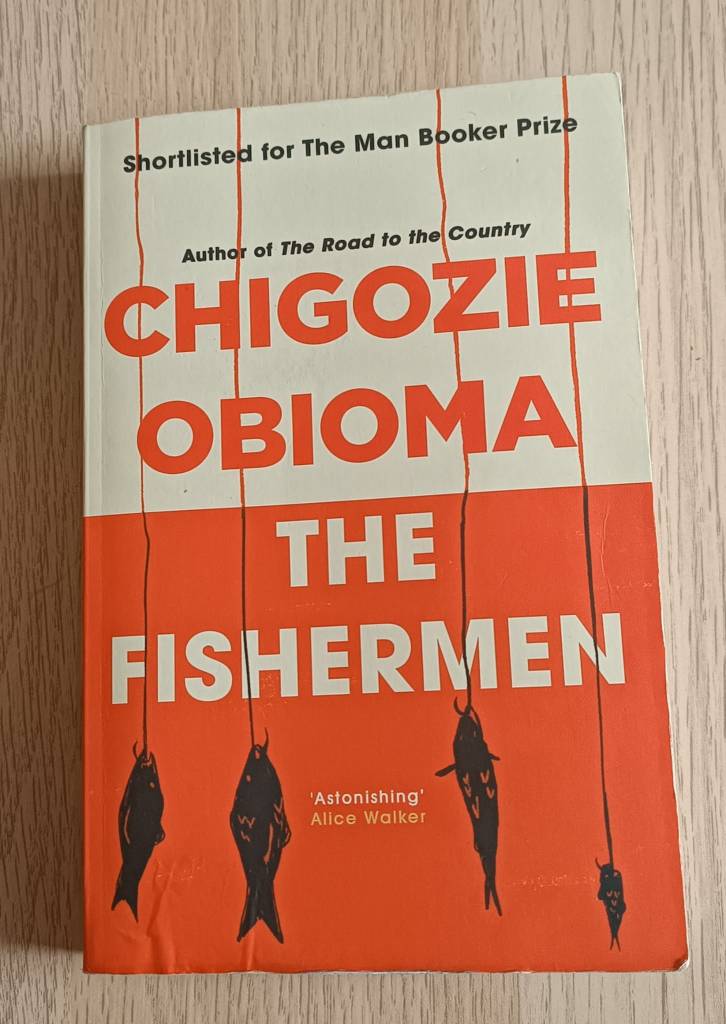
The Fishermen is a novel whose story focuses on four brothers living in Akure, Nigeria. The main protagonist, Ben, narrates how they became fishermen after their father moved to a different part of the country due to a job transfer. His departure leaves the boys with more freedom and daringness than they could afford before. Their lives take a tragic turn when, one day, during one of their fishing expeditions, they meet Abulu, the village madman, who predicts that the eldest brother will be killed by a fisherman.
This prophecy forms the backbone of the book as the author masterfully reveals the different personalities of the brothers, which ultimately influence their decisions.
The themes that resonated most with me were:
Family Roles
As in many African countries, the father is considered the head of the family. He instills discipline and is more respected (or even feared) by the children.
Set in 1990s Nigeria, the book clearly portrays this role. The boys are more afraid of their father than their mother. They dread his wrath and beatings whenever they do something wrong. Were it not for their father’s absence, as narrated by the main protagonist, they would not have become fishermen.
The mother assumes the role of taking care of the house and the children. She also tries to discipline the boys in her own ways but is sometimes overwhelmed. She resorts to making threats, taking note of any form of disobedience, and reporting the boys to their father once he comes back.
Apart from the parents, the book also touches on the roles of older siblings, who often take up the responsibility of leading the younger ones. However, this role can also be problematic, especially when the younger ones become totally dependent on and blindly follow their older sibling.
Family Wrangles
Fights and misunderstandings are normal occurrences in any family setup, but to what extent can they escalate and destroy a relationship?
The conflict between the eldest and the second-born son of the family is significant in the book. Their constant fights eventually contribute to the destruction of the family, notwithstanding the madman’s prophecy.
The other brothers’ trust in each other is also put to the test in various instances.
Parents’ Hopes and Dreams for Their Children
“I will tell you that you could be different kinds of fishermen. Not that kind that fish in a filthy swamp like the Omi-Ala, but fishermen of the mind. Go-getters. Children who will dip their hands into the rivers, sea, ocean of life and become successful: doctors, pilots, professors, lawyers.”
Pg. 51
Since the introduction of Western education, many African parents have envisioned a better future for their children. Growing up, education was emphasized as the “only way” to get a family out of poverty. Of course, this has changed over time, with many graduates in African countries currently struggling to find jobs. Nevertheless, education is still highly valued, and this is no different in the book.
The fishermen’s father is strict and expects nothing but good school reports and success from his boys. He has even chosen career paths for each one of them.
Prayers and Prophecies
When I was young, my mother would invite a priest from one of those strange religious groups to come and pray in our house. Every time after the prayers, he would tell my parents about his prophecies, which almost always involved a family member who was jealous of us and was practising witchcraft against the family. I don´t know how much my parents, especially my mother, believed in his prophecies.
Reading this book reminded me of those times. To date, in many African religious contexts, there are priests with large followings who are convinced of their prophecies.
The Fishermen, however, presents prophecy from a different angle, making the book even more thrilling. A madman, believed to have evil powers, gives unsolicited prophecies to the village members. Some of the villagers believe him and swear to have witnessed his prophecies come true. The eldest brother, Ikenna, also becomes a victim of the madman’s prophecy, which ultimately shapes the story of the fishermen.
Symbolism
“Ikenna was a python: A wild snake that became a monstrous serpent living on trees, on plains above other snakes…”
The author’s use of animals to describe the traits of the main characters made the book a magnificent read. Each animal-to-human character depiction broadened my imagination as a reader, making me anticipate the impact of these animal characteristics on the story.
Conclusion
I’m a big lover and hater of suspense. But I enjoyed reading the book so much, not only because of the suspense but also because of how well it was written. Chigozie has mastered the art of storytelling, and at some point, I felt like I was watching a film.
I was transported into the world of the fishermen. I accompanied them as they made their first mistake of fishing in the forbidden river, held my breath a little as the brothers fought, held my breath a lot more as they fought the madman, and finally breathed a sigh of relief at the end.
 Rafiki Book Circle
Leave a comment